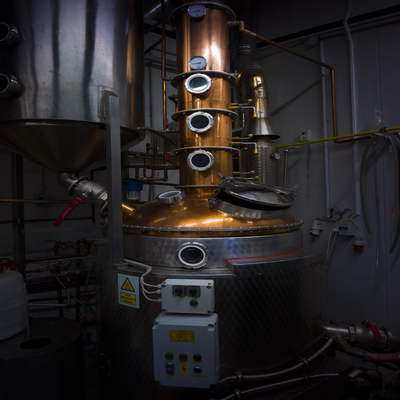
Inside the Copper Still: Slow Distillation, Explained
There are faster ways to make spirit. We chose the slow one on purpose. A look at what really happens inside a copper pot still — and why patience is the most important ingredient we have.
If you've ever wondered why small-batch spirits cost more than the bottles on the supermarket shelf, the answer is usually the same: time. Industrial column stills run continuously and strip everything down to neutral alcohol. A copper pot still does the opposite — it keeps the character, and it takes its time.
Why copper?
Copper isn't decorative. As the vapour rises, it reacts with the metal and removes harsh sulphur compounds that would otherwise make the spirit taste sharp and vegetal. Stainless steel can't do this. The shine on our still is, quite literally, doing chemistry.
“The still doesn't make the spirit. It reveals what the fermentation already created — and quietly throws away the parts you don't want.”
Heads, hearts, and tails
Every distillation run separates into three rough parts, and knowing where to cut between them is the distiller's real craft:
- Heads — the first vapour off the still, light and volatile. We discard most of it.
- Hearts — the clean middle. This is the only part that goes into the bottle.
- Tails — the heavy, oily end of the run. Set aside and redistilled.
The cuts are made by nose and by taste, not by a timer. It's the part of the job that can't be automated, and the part we'd never want to.
Slow on purpose
A gentle, slow run gives the copper more contact time and the cuts more precision. We could push the still harder and double our output. We don't — because everything we'd gain in volume, we'd lose in the glass.